Best Ways to Make Money Online in 2026: Digital Products vs. Freelancing vs. Dropshipping
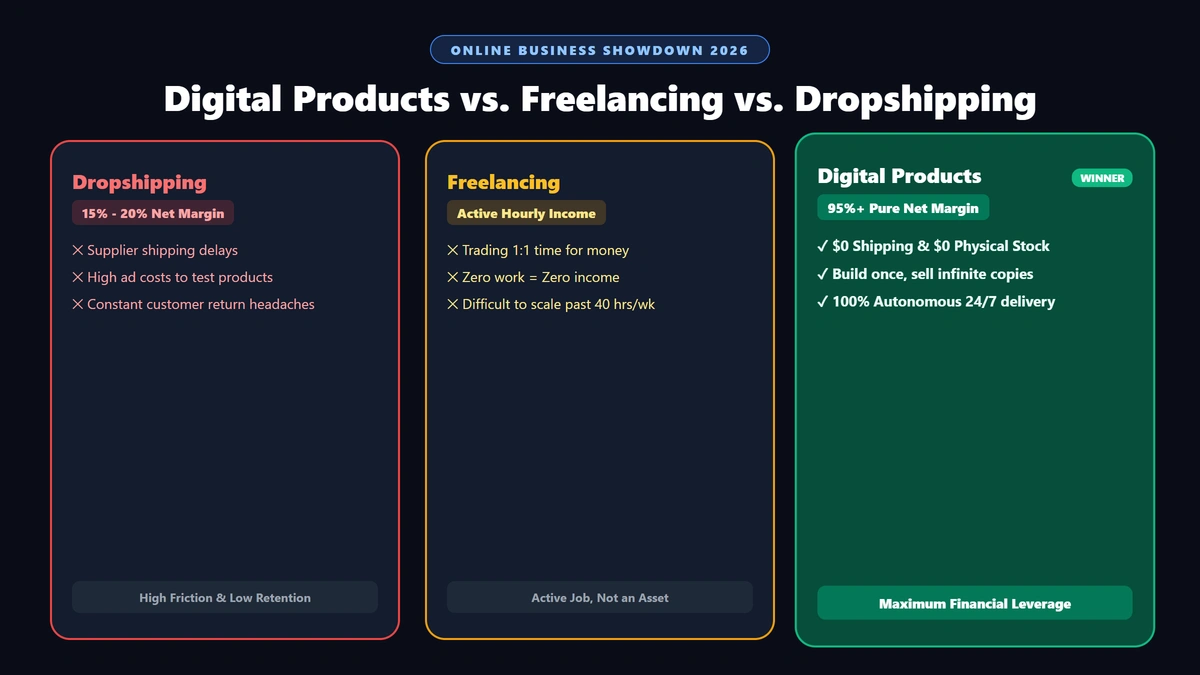
If you are evaluating online business models in 2026, you inevitably face three dominating choices: freelance client services, physical dropshipping / e-commerce, or digital products commerce. While all three can generate revenue, the underlying mechanics of profit margins, capital risk, and time freedom could not be more divergent: digital products deliver 95%+ pure profit margins with zero inventory headaches, shipping disputes, or grueling client calls.
💡 Core Insights from this Analysis:
- The Unit Economics Matrix: Comparing initial capital, net margins, and operational risk across all three models.
- The Freelance Ceiling: Why service providers remain trapped trading active hours for income regardless of hourly rates.
- The Dropshipping Margin Squeeze: Skyrocketing paid ad costs and supplier shipping delays eroding physical e-commerce margins.
- The Decision Matrix: Selecting the optimal business model aligned with your budget, technical skills, and lifestyle goals.
1. Comprehensive Unit Economics Comparison Table
| Business Metric | Freelance Services | E-Commerce Dropshipping | Digital Products Commerce |
|---|---|---|---|
| Startup Capital Required | $0 (Requires proven elite skill) | $500 - $3,000 (Ad spend & testing) | $0 - $20 Total |
| Net Profit Margin | 100% (Trading active lifetime hours) | 10% - 20% (Eaten by ad CPAs & shipping) | 95% - 98% Pure Retained Margin |
| Monthly Revenue Ceiling | Capped by 24 daily hours | High (Constrained by cash flow for ads) | Uncapped (Infinite digital replication) |
| Returns & Customer Support | Constant scope creep & revisions | Damaged items, lost packages, chargebacks | 100% Automated Instant Download |
| True Passive Income Potential | Zero (Income halts when you stop) | Low (Constant supplier and customer triage) | Maximum (Sales run 24/7 globally) |
| Barrier to Entry | High (Requires extensive portfolio) | Moderate (Requires ad copy & testing skills) | Very Low & Immediate |
2. In-Depth Breakdown of the 3 Business Models
1. Freelancing & Service Delivery
- The Promise: Immediate cash flow if you possess high-ticket skills such as coding or copywriting.
- The Reality in 2026:
- You trade one corporate manager for 5 demanding clients.
- Zero leverage; when you fall sick or travel, your revenue stream instantly dries up.
- Burnout caused by endless client revisions and unpaid administrative overhead.
2. Physical E-Commerce & Dropshipping
- The Promise: Selling tangible consumer goods with high market demand.
- The Reality in 2026:
- Escalating ad acquisition costs on TikTok and Meta consuming 80%+ of gross margins.
- Supplier shipping delays and customs friction causing payment gateway freezes.
- High return rates and constant customer support friction.
3. Digital Products Commerce (The Strategic Winner)
- Why Digital Assets Dominate:
- Infinite Leverage (Create Once, Sell Forever): You build a master planner, coloring book, or flashcard deck once and sell 10,000 copies with zero manufacturing overhead.
- Zero Financial Risk: You never buy upfront inventory or carry dead stock risk.
- Organic Marketplace Traffic: Marketplaces like Etsy and Amazon KDP connect your products directly with millions of high-intent searchers without paid advertising.
- Instant Automated Creation: Specialized software like Digital Products Maker allows anyone to generate commercial-grade, print-ready 300 DPI PDF products in minutes.
3. Decision Matrix: Which Model Fits Your Goals?
- Choose Freelancing: If you have an established technical craft, enjoy direct client interaction, and prefer trading active hours for immediate cash flow.
- Choose Dropshipping: If you possess at least $2,000 in risk capital to test paid ad creatives and have experience managing supply chain logistics.
- Choose Digital Products (Recommended): If you want to build scalable, automated assets with 95% profit margins, zero startup risk, and complete time freedom.
4. Frequently Asked Questions (FAQ)
Can I combine freelance skills with digital products?
Yes! Packaging your specialized knowledge into downloadable templates, planners, and resource toolkits allows you to monetize audiences who cannot afford custom 1-on-1 agency fees.
Is the digital products market saturated in 2026?
Only low-effort, generic files face saturation. High-utility, beautifully formatted assets tailored to focused micro-niches (e.g. bilingual educational flashcards or 300 DPI wall art) experience continuous daily buyer demand.
What is the fastest way to launch my first digital asset?
Pick a verified search niche, use automated generation tools to compile a print-ready PDF, and publish it on an organic marketplace like Etsy or Gumroad.
Summary and Final Recommendation
If your primary objectives are operational peace of mind, zero upfront capital risk, and building genuine passive income that compounds while you sleep, digital products represent the absolute pinnacle of online commerce in 2026. Start building your first digital asset catalog today and claim your financial leverage.